Books

R. A. Aumiller, Hegel, Marx, and the Laughing Matter of Spirit. (Northwestern University Press, 2025)
order: Amazon; Northwestern UP
What happens when those who have been denied political subjectivity fully play out their negative role in a historical drama that damned them from the beginning? Hegel, Marx, and the Laughing Matter of Spirit locates the eruption of revolutionary laughter in historical cracks across nineteenth- and twentieth-century Europe, where exiled philosophers, partisan fighters, and artists framed their political resistance as a historical comedy. Hegelian comedy fuels the Young Hegelian critique of Prussian censorship, Walter Benjamin’s staging of the anti-fascist resistance, and the Yugoslavian partisan attempt to begin again in fascism’s aftermath. Revolution erupts from a historical stage that can no longer look on its own contradictions with a straight face. Drawing on the defiant spirit of comedy, this Hegelian feminist manifesto defies political despair, overturning the perception that history tragically repeats itself. Invoking the phrase “Nothing changes” as a mantra, R. A. Aumiller turns a concession of defeat into a battle cry for political resistance.
PRAISE
“In crisis-ridden moments, critical thought must not forget to sharpen the one tool that helps us handle impossible political situations: wit. R. A. Aumiller shows us how it’s done, through an admirable return to Hegel, whose philosophical comedy remains an indispensable guidance in troublesome times. Hegel, Marx, and the Laughing Matter of Spirit demonstrates that philosophy, if it truly wants to perform its task, must practice a materialist humor that will make the spirit of time, literally, “crack up”. Only through such comical act, a change other than tragic downfall becomes possible. So, this book is indeed a matter of urgency.” Samo Tomšič, Dresden University of Fine Arts
“Hegel, Marx, and the Laughing Matter of Spirit is brilliant, mordant, and politically astute—a powerful riposte to “left wing melancholia,” to the pieties of memory politics, and the heroics of failure. At a time of global counterrevolution, this eloquent manifesto could not be more urgent reading.” Rebecca Comay, University of Toronto
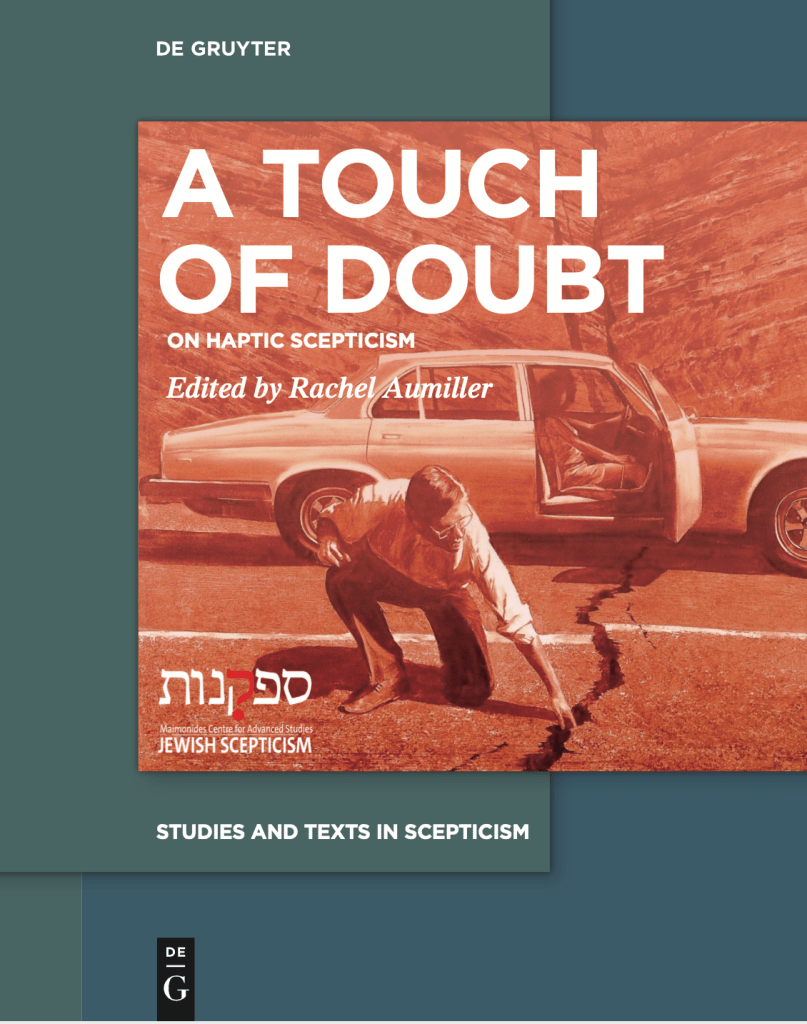
R. A. Aumiller (Ed). A Touch of Doubt: On Haptic Scepticism. (Walter de Gruyter, 2020)
Book Release Event with Authors
A Touch of Doubt traces the theme of touch in the evolution of skepticism through Platonism, German idealism, Continental philosophy and psychoanalysis. Haptic Scepticism, the field of ethics emerging from this study, explores the grasp-ability of contradiction. Contradiction is a haptic marvel. We can cup it in our palms, press it against our lips, dip our toes into its coolness, and, if we are not careful, we may even burn ourselves on its surface.

Aumiller, R. A. ; Dolbear, Sam ; Fleming, Paul & Vandeputte, Tom (Eds) Walter Benjamin’s “Fate and Character” Diacritics 52 (4), open access.
Walter Benjamin’s ‘Fate and Character’ occupies a curious status in the reception of his work. Published in 1921 but composed in the fall of 1919, the essay was part of the constellation of writings translated into English in the late 1970s. Benjamin repeatedly stressed the significance of the essay, and reports that he counts it “among the best of [his] works.” Despite this, and perhaps because of its highly condensed and enigmatic quality, the text has not received the same critical attention as the other texts from the same period. And yet ‘Fate and Character’ can be considered as the text where Benjamin first engages with the constellation of themes central to his political writings, urgent questions of our moment as much as his: the critique of law, the notion of bare life, the persistence of myth in modernity, the “improper” temporality of fate, and the formation of the subject in history. This special issue of Diacritics is entirely dedicated to this puzzling eight-page text. What is at stake, however, is not only an examination of the relevance of ‘Fate and Character’ for the study of Benjamin’s writings, but also an exploration of how the constellation of themes structuring the essay may speak to a broader range of discussions across the humanities today.

